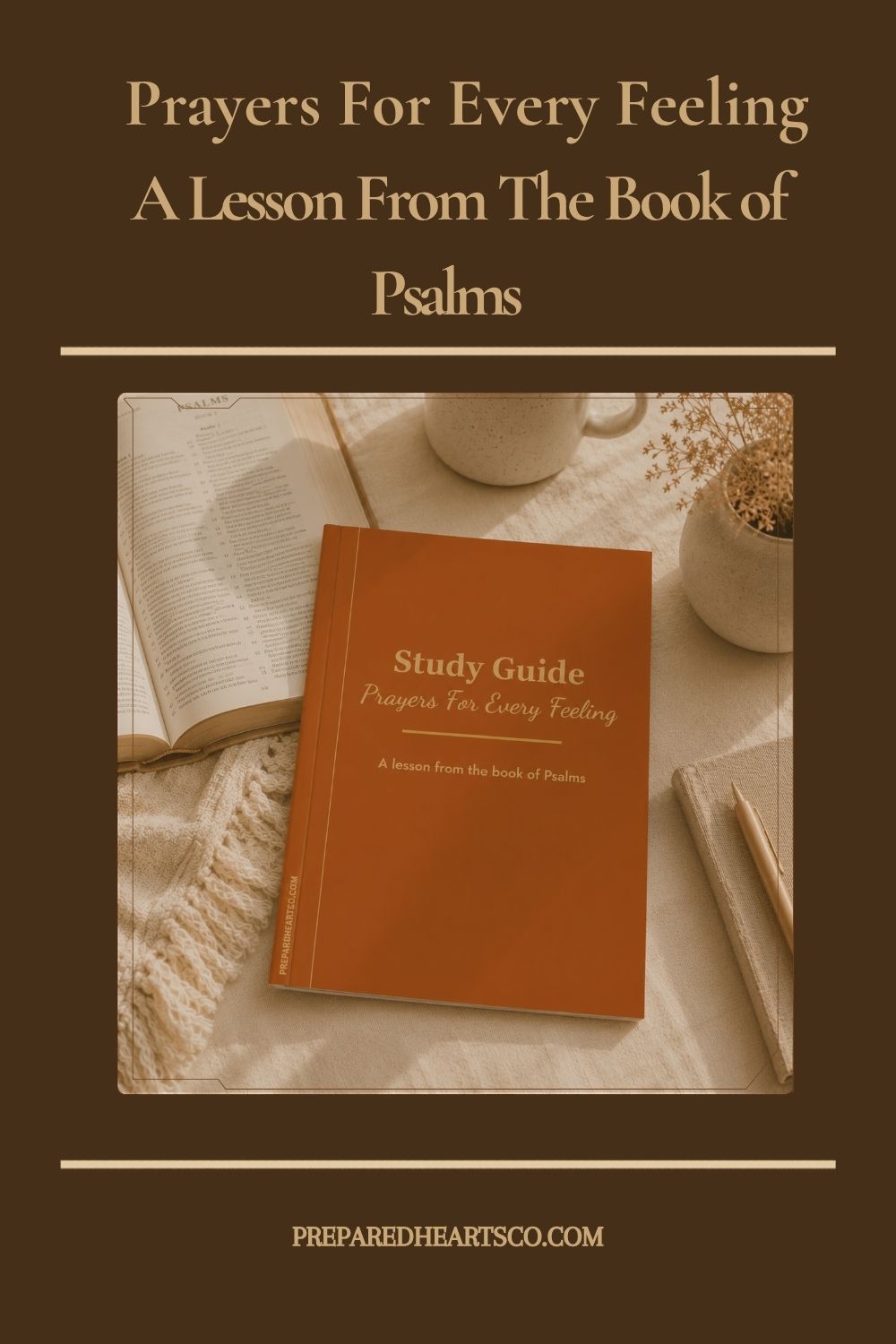
Prayers for Every Feeling
A 6-week journey through the Psalms — laments, songs of trust, praise, and everything in between.
Always available — purchase anytime
- Instant digital access
- Lifetime access
- 14-day money-back guarantee
- Secure checkout by Stripe
- Delivered straight to your inbox
The Psalms give us language for every emotion. This guide pairs selected psalms with reflection, journaling, and prayer practice — perfect for personal study or small groups.
What you'll walk through
- 01Week 1Psalms of Trust
- 02Week 2Psalms of Lament
- 03Week 3Psalms of Praise
- 04Week 4Psalms of Repentance
- 05Week 5Psalms of Wisdom
- 06Week 6Psalms of Thanksgiving
Every week, day by day
Tap any week to open daily readings, reflection questions, a memory verse, a worksheet, and group discussion prompts.
Selected Psalms · 6 weeks · All levels
A 6-week journey through the Psalms — laments, songs of trust, praise, and everything in between.
Week 1: Psalms of Trust
We begin where the Christian life always begins: trust. These psalms give us language for resting in God when life feels uncertain.
Memory verse — "The Lord is my shepherd, I lack nothing." (Psalm 23:1)
Daily readings
Day 1 — The Lord My Shepherd — Psalm 23
The most familiar psalm — and worth slowing down for. A shepherd leads, provides, restores, walks through valleys, sets a table, anoints, follows with goodness. Every verb is His.
Reflect:
- Which verb of the Shepherd do you most need today?
- Where is He leading you that feels like a 'valley'?
Pray: Shepherd, lead me today. I will follow. Amen.
Day 2 — My Refuge and Fortress — Psalm 91
God is a refuge — a place to run. The imagery is of wings, a shield, a tower. He is not distant in our danger.
Reflect:
- What does running to God as your refuge look like in practice?
- What fear is loudest right now? Bring it to the refuge.
Pray: Father, You are my refuge. I run to You. Amen.
Day 3 — Be Still and Know — Psalm 46
Even when the earth gives way, God is our ever-present help. The famous 'be still' is less a soft invitation and more a command to stop striving and recognize who God is.
Reflect:
- Where is the 'earth giving way' in your life?
- What does it look like for you to 'be still' this week?
Pray: Lord, I am still. You are God. Amen.
Day 4 — Whom Shall I Fear? — Psalm 27
David asks the question that quiets every fear: 'The Lord is my light and my salvation — whom shall I fear?' He chooses one thing: to dwell in God's presence.
Reflect:
- What 'one thing' are you seeking right now?
- How does dwelling with God reframe what you fear?
Pray: Lord, my one thing is You. Amen.
Day 5 — A Quieted Heart — Psalm 131
A short, tender psalm. David quiets his soul like a weaned child with its mother. Trust isn't always loud. Sometimes it's a quiet leaning.
Reflect:
- What is troubling your heart that you need to lay down?
- What does a 'weaned-child' kind of trust look like for you?
Pray: Father, quiet my soul. I lean on You. Amen.
Week 1 Worksheet — Trust
- Rewrite Psalm 23 as a personal prayer.
- List 3 fears. Beside each, write a truth from this week's psalms.
- Practice 'be still' for 5 minutes. Journal what you notice.
- Identify your 'one thing' from Psalm 27:4.
Group discussion
- Which psalm of trust spoke loudest this week? Why?
- Where in your life do you most need to 'be still'?
- How is God your refuge right now?
- Share your 'one thing' from Psalm 27.
- Pray Psalm 131 over one another.
Week 2: Psalms of Lament
Scripture honors honest grief. Lament is not unbelief — it is faith bringing its pain to God. This week we learn to grieve with hope.
Memory verse — "The Lord is close to the brokenhearted and saves those who are crushed in spirit." (Psalm 34:18)
Daily readings
Day 1 — How Long, O Lord? — Psalm 13
David asks 'how long?' four times in two verses. He doesn't pretend. But by the end, he chooses to trust. Lament has a shape: cry out, ask, remember, trust.
Reflect:
- What 'how long?' are you carrying?
- What truth can you choose to remember today?
Pray: Lord, how long? And yet — I trust in Your unfailing love. Amen.
Day 2 — From the Depths — Psalm 130
'Out of the depths I cry to you.' The psalmist waits for the Lord more than watchmen wait for morning. Hope in the dark is still hope.
Reflect:
- What 'depth' are you crying from?
- What does 'waiting for the Lord' look like in this season?
Pray: Father, hear my cry. I wait for You. Amen.
Day 3 — Why Are You Downcast? — Psalm 42
The psalmist preaches to his own soul: 'Why are you downcast? Hope in God.' We don't always feel hope — sometimes we have to preach it to ourselves.
Reflect:
- What does your soul need to hear today?
- What can you preach to yourself from Scripture this week?
Pray: Lord, I will yet praise You — my Savior and my God. Amen.
Day 4 — Forsaken? — Psalm 22
Jesus quoted this psalm from the cross. It begins in agony — 'My God, my God, why have You forsaken me?' — and ends in worship. Even our darkest cries can become songs of praise.
Reflect:
- Where do you feel forsaken?
- How does Jesus' use of this psalm change how you read it?
Pray: Jesus, You know forsakenness. Meet me here. Amen.
Day 5 — Close to the Brokenhearted — Psalm 34
'The Lord is close to the brokenhearted.' He is not distant in our grief. He is closer in it than in any other season.
Reflect:
- Where is God closer than you realize right now?
- What broken place needs His nearness today?
Pray: Lord, thank You for being close. Amen.
Week 2 Worksheet — Lament
- Write your own lament psalm using the shape: cry out, ask, remember, trust.
- List 3 truths to 'preach to your soul' this week.
- Read Psalm 22 aloud. Mark where it shifts from grief to praise.
- Write a thank-you to God for being close to the brokenhearted.
Group discussion
- Why is lament a healthy part of faith?
- Share a 'how long?' you're carrying. The group will pray.
- How do you preach truth to your own soul?
- How does Psalm 22 deepen your understanding of the cross?
- Where is God close to you in brokenness right now?
Week 3: Psalms of Praise
Praise isn't denial of pain — it's defiance against it. These psalms train our hearts to lift our eyes higher than our circumstances.
Memory verse — "Praise the Lord, my soul; all my inmost being, praise his holy name." (Psalm 103:1)
Daily readings
Day 1 — Bless the Lord, O My Soul — Psalm 103
David lists God's benefits: forgives, heals, redeems, crowns, satisfies, renews. Praise often begins with remembering.
Reflect:
- Which 'benefit' do you most need to remember today?
- What would it look like to 'bless the Lord' with your whole self?
Pray: Lord, I bless You with all that is within me. Amen.
Day 2 — How Majestic Is Your Name — Psalm 8
David looks at the heavens and is undone. He wonders why God would mind us at all — and yet He crowns us with dignity. Praise expands our view of God and our place in His story.
Reflect:
- When did you last simply marvel at God's creation?
- How does His attention to you change how you walk today?
Pray: Majestic God, thank You for thinking of me. Amen.
Day 3 — Make a Joyful Noise — Psalm 100
Five short verses, full of joyful command. Worship, serve, come, enter, give thanks. Praise is participation, not performance.
Reflect:
- What posture of praise do you most need this week?
- Where can you 'enter His gates with thanksgiving' today?
Pray: Lord, I come with joy. I am Yours. Amen.
Day 4 — Praise from Everything — Psalm 148
Sun, moon, stars, sea creatures, weather, kings, young women, old men — everything is called to praise. You are part of a much larger choir.
Reflect:
- Where do you most need to remember you're not the only voice praising?
- What part of creation reminds you to worship?
Pray: Lord, my voice joins all creation in worship. Amen.
Day 5 — Let Everything That Has Breath — Psalm 150
The final psalm is pure praise. Every instrument, every breath, every place — praise the Lord. This is what we were made for.
Reflect:
- What does it mean that you were made for praise?
- How can your breath this week be praise?
Pray: Lord, every breath is Yours. Amen.
Week 3 Worksheet — Praise
- List 10 'benefits' from Psalm 103 you've personally experienced.
- Write your own Psalm 8 — what does God's creation say to you?
- Plan 3 specific moments this week to 'enter with thanksgiving.'
- Write your own short Psalm 150 — using your life as the instruments.
Group discussion
- What benefit of God's are you most grateful for today?
- How does praise change your perspective in hard seasons?
- Share a moment creation moved you to worship.
- What posture of praise do you most need to practice?
- What were you made for?
Week 4: Psalms of Repentance
These psalms teach us how to come home. Honest confession is not the end of joy — it's the doorway back to it.
Memory verse — "Create in me a pure heart, O God, and renew a steadfast spirit within me." (Psalm 51:10)
Daily readings
Day 1 — Have Mercy on Me — Psalm 51:1-6
David doesn't hide. He asks for mercy on the basis of God's character, not his own. True repentance starts with honesty about what is.
Reflect:
- Where are you hiding today?
- What truth do you need to acknowledge before God?
Pray: Father, have mercy on me. Amen.
Day 2 — Wash Me Clean — Psalm 51:7-12
'Create in me a pure heart.' Repentance asks God to do the deep work we cannot do ourselves. Only He can create — not just clean — a new heart.
Reflect:
- What heart-work are you trying to do that only God can do?
- What would 'a clean heart' free you for?
Pray: God, create in me a clean heart. Renew me. Amen.
Day 3 — A Broken and Contrite Heart — Psalm 51:13-19
God doesn't want our performance. He wants our broken, contrite hearts. Brokenness, in God's economy, is the beginning of beauty.
Reflect:
- Where is God inviting you into brokenness over what you've defended?
- What does 'contrite' mean for your daily life?
Pray: Lord, You will not despise a broken heart. Thank You. Amen.
Day 4 — When I Kept Silent — Psalm 32
David describes the misery of unconfessed sin and the joy of forgiveness. Confession is not God's punishment — it's His path to freedom.
Reflect:
- What have you been silent about?
- What would confession set free?
Pray: Father, I confess. Thank You for not counting it against me. Amen.
Day 5 — As Far as the East — Psalm 103:8-14
God removes our sins 'as far as the east is from the west.' He remembers we are dust. His compassion is not stingy. Forgiveness is full.
Reflect:
- What sin do you keep picking back up that God has already removed?
- How does His compassion change how you walk today?
Pray: Lord, thank You for compassion that knows my frame. Amen.
Week 4 Worksheet — Repentance
- Pray Psalm 51 slowly. Write what God brings to mind.
- List anything you've been silent about. Confess each.
- Write a thank-you for one specific forgiveness you've received.
- Draw an east-to-west line. Write what God has removed.
Group discussion
- Why is confession often hard — even though it leads to freedom?
- What does 'a broken and contrite heart' look like in practice?
- How does Psalm 32 describe the relief of confession?
- Where do you need to stop picking up what God has already removed?
- Pray Psalm 51 over one another.
Week 5: Psalms of Wisdom
These psalms teach us how to live well. They are less about feelings and more about formation — shaping our days around what is true.
Memory verse — "But whose delight is in the law of the Lord, and who meditates on his law day and night. That person is like a tree planted by streams of water." (Psalm 1:2-3)
Daily readings
Day 1 — Two Ways to Live — Psalm 1
The psalter opens with a choice: the way of the righteous and the way of the wicked. The righteous are rooted, fruitful, lasting. The wicked are like chaff, blown away.
Reflect:
- What are you 'planted' beside? What feeds your roots?
- Where do you need to pull up roots that aren't life-giving?
Pray: Father, root me in You. Amen.
Day 2 — Teach Us to Number Our Days — Psalm 90
Moses asks God to teach us the brevity of life so we live with wise hearts. Time, well-numbered, becomes a teacher.
Reflect:
- What does it mean to 'number your days'?
- What would change if you lived this week aware of its limits?
Pray: Lord, teach me to number my days. Amen.
Day 3 — Your Word Is a Lamp — Psalm 119:97-112
The longest psalm is a love song to God's Word. 'Your word is a lamp for my feet, a light on my path.' Wisdom comes from sustained meditation on Scripture.
Reflect:
- How is your relationship with Scripture right now?
- What is one rhythm you could build this week?
Pray: Lord, your Word is sweet. Make me hungry for it. Amen.
Day 4 — Search Me, O God — Psalm 139
God knows us fully — and still draws near. The psalm ends with David inviting that knowing: 'Search me, O God, and know my heart.' Wisdom begins with being fully known.
Reflect:
- Where do you most want to be fully known?
- What would change if you welcomed God's searching gaze?
Pray: Father, search me. Lead me in the way everlasting. Amen.
Day 5 — Like Children Loved — Psalm 127
'Unless the Lord builds the house, the builders labor in vain.' Wisdom rests; it does not strive. We are loved children, not exhausted hustlers.
Reflect:
- Where are you 'building' in your own strength?
- What would it look like to rest in being a loved child?
Pray: Father, I rest. You are building. Amen.
Week 5 Worksheet — Wisdom
- Draw a tree. Label your roots — what feeds your soul?
- Number the days you have left in this year. Write one prayer.
- Plan a Scripture rhythm for the coming week.
- Write 'Search me, O God' as a prayer in your own words.
Group discussion
- What feeds your roots? What needs to be pulled up?
- How would your week change if you 'numbered your days'?
- Share a Scripture passage that has shaped your wisdom.
- What does it mean to be fully known by God?
- Where do you need to stop 'building in vain'?
Week 6: Psalms of Thanksgiving
We close where every Christian life is heading: a heart that overflows with thanks. These psalms remind us that thanksgiving is the language of the redeemed.
Memory verse — "Give thanks to the Lord, for he is good; his love endures forever." (Psalm 107:1)
Daily readings
Day 1 — Give Thanks, For He Is Good — Psalm 107:1-22
The psalmist tells story after story of God's rescue — and ends each with the refrain: 'Let them give thanks.' Remembering rescue produces gratitude.
Reflect:
- Where has God rescued you?
- What story of His goodness can you tell this week?
Pray: Lord, thank You. You are good. Amen.
Day 2 — Bless the Lord at All Times — Psalm 34:1-10
David blesses the Lord 'at all times' — not just the easy ones. Thanksgiving in seasons of plenty is honest; thanksgiving in seasons of want is sanctifying.
Reflect:
- What is hard to give thanks for right now?
- What can you bless God for today?
Pray: Lord, I will bless You at all times. Amen.
Day 3 — Enter with Thanksgiving — Psalm 100
Thanksgiving isn't just response — it's invitation. It opens the door into His presence.
Reflect:
- How does thanksgiving open your heart to God?
- What practice of thanksgiving can you build?
Pray: Father, I enter with thanks today. Amen.
Day 4 — Forget Not His Benefits — Psalm 103:1-12
The biggest enemy of thanksgiving is forgetfulness. The psalmist commands his soul: 'Forget not all His benefits.'
Reflect:
- What 'benefit' have you forgotten that needs to be remembered?
- How does remembering reset your heart?
Pray: Lord, forgive my forgetting. Renew my remembering. Amen.
Day 5 — Praise Him with Your Whole Life — Psalm 145
David's last alphabetical psalm is exuberant thanks. 'Every day I will praise You.' This is the rhythm of the redeemed.
Reflect:
- What does 'every day I will praise You' look like for you?
- Looking back over 6 weeks — what is your biggest thanks?
Pray: Lord, every day. Forever. Amen.
Week 6 Worksheet — Thanksgiving
- Write a 'rescue story' from your life. End with 'Let me give thanks.'
- List 10 specific thank-yous from this week.
- Build a 'forget not' list — 5 benefits to remember daily.
- Reflect on the full study: what one truth will you carry forward?
Group discussion
- Share a rescue story and give thanks together.
- What is hard to give thanks for right now?
- How can thanksgiving become a daily rhythm in your life?
- What 'benefit' have you been forgetting?
- Looking back over 6 weeks — what has changed in you?
questions
Frequently asked
How do I access my purchase?
After checkout, you'll receive an email with secure download links. You can also access your library any time from your account.
What's your refund policy?
If a resource doesn't bless you within 14 days, just reply to your receipt and we'll refund you, no questions asked.
Can I share with my small group?
Yes — feel free to use it with your small group. Each member is welcome to enjoy and engage with the material together.